

USD
The Fed hiked, and this time the Dollar listened.
Wednesday’s 25bp to 3.75–4.00% was unanimous. It was the first hike since July 2023, and the committee signaled at least one more before year-end. The market took Warsh at his word: DXY gained 1.1% on the week to 100.22, the best level in about six weeks, and the 10Y is parked right at 5.00%. Kashkari added fuel on Sunday, saying price pressure has spread beyond the oil shock. That’s the real shift, because this is no longer an “oil in, oil out” story. Brent is already easing (around $102 today, with Saudi flows coming back), and the Dollar gave nothing back. This week is light on data and heavy on Fed talk. Flash PMIs come Wednesday, claims Thursday, and durables and final UoM Friday (1Y inflation expectations seen at 4.6%). Trump–Xi on Thursday is the wildcard. The real test is PCE next Wednesday. Overall skew: Dollar supported on dips, but holding above 100 needs PCE to confirm.
EUR
Priced for hikes, trading like it doesn’t believe them.
EUR/USD lost 1% to 1.1485, back at the late-July lows. Markets still carry roughly 50/50 odds of another ECB hike this year, with the deposit rate priced just under 2.9% by December. But once the Fed moved, the rate spread turned against the euro. Some are already arguing ECB pricing is too high: energy at these levels kills growth before it kills inflation. That argument gets tested Wednesday with flash PMIs (composite 52.0 prior) and Thursday with the Ifo (89.2 expected). Consumer confidence is out Tuesday, Lane speaks twice and Schnabel on Thursday. Overall skew: soft. A PMI miss pulls ECB pricing lower and brings 1.14 into view. Upside needs lower oil and softer US data at the same time.
GBP
BoE on hold, pound on the back foot.
Cable fell 1% to 1.3395, near its weakest since late July. The BoE held at 3.75% on a 6–3 vote and warned that a prolonged Middle East conflict could force a hike. It also slowed QT to £46bn a year, below the £50bn the market expected. August CPI at 3.1% (core stuck at 2.6% for a fourth month) and a surprise +0.5% in retail sales keep November live, but with less conviction as oil retreats. This week brings public finances Tuesday, flash PMIs Wednesday, and Bean, Dhingra and Breeden on Thursday. Overall skew: neutral to soft vs USD. If you want sterling, EUR/GBP at 0.858 is the cleaner expression, since relative rates still favor the pound.
JPY
A hike with two dissents reads as a dovish hike.
The BoJ lifted its rate to 1.25%, the highest since 1995. But Asada and Sato voted against, and Ueda kept stressing that conditions stay accommodative. The market heard “slower than the Fed,” and USD/JPY ran 2.1% on the week to 156.87. Core CPI slipped to 1.7% in August, which doesn’t help the hawks. Now the risk flips. There are reports of a BoJ rate check late Friday, and Tokyo is on holiday Monday to Wednesday. Thin markets are exactly where Japanese authorities have stepped in before. Flash PMI is out Thursday. Overall skew: no chase above 157. Carry says higher, but intervention risk means the path there will be violent. Selling rallies into 158–160 beats buying breakouts.
CHF
The new funding currency.
USD/CHF hit 0.822, the weakest franc since May 2025, and EUR/CHF sits at 0.944. The story isn’t Swiss. The yen has lost its appeal as a funding currency after BoJ tightening and the joint US–Japan intervention. Carry has rotated into the franc instead, because it is cheap to borrow and stable. The SNB decides Thursday, and 0% is fully expected. August CPI at 0.8% (a two-year high) and the strongest GDP growth in nearly five years leave no case for easing and no urgency to hike. Watch the language on FX: a weaker franc is exactly what the SNB wanted. Current account comes Tuesday. Overall skew: franc weakness has room while volatility stays low. The Middle East is the one thing that could flip it back to haven mode fast.
AUD
Best of the rest.
AUD lost only 0.6% against a rampant Dollar to close at 0.7121. AUD/NZD is at 1.2445, up almost 11% on the year, and Aussie is still up 6.7% YTD, among the strongest in G10. This week has substance: Flash PMIs come Tuesday night (composite 52.7 prior), and August jobs land Thursday. The consensus is +20k after July’s -15.8k, with unemployment at 4.5%. Trump–Xi on the same day is a bigger swing factor for AUD than anything domestic. Overall skew: constructive on crosses, neutral vs USD. Long AUD/NZD remains the cleanest divergence trade.
NZD
Fourth weekly loss in a row.
Kiwi fell 1.6% to 0.5721, near a ten-week low. Q2 GDP beat (+0.2% q/q vs +0.1% expected, where the RBNZ had penciled in zero), and the August trade gap came in smaller. It didn’t matter. The market still prices about 60% for an October hike to 3.0%, so the good news is largely in the price. The domestic calendar is quiet, so the kiwi trades off the Dollar and risk sentiment. Overall skew: soft. There’s no reason to catch this before the RBNZ gives one.
CAD
Oil is leaving, and the Loonie is going with it.
USD/CAD rose 0.8% to 1.3986 and opened the week above 1.40. Brent is back toward $100 and WTI is under $100 as Saudi flows through the East-West pipeline recover. That removes Canada’s oil cushion just as the Fed widened the rate gap. Retail sales are out Thursday: July is seen at -0.8% after +0.6%, with a flash read for August. Overall skew: higher bias in USD/CAD while oil drifts lower, and a weak retail print adds to it.
Cross-Asset Notes
Rates hit FX, not stocks. Oil is giving back its premium, copper won’t stop.
The S&P closed the Fed week flat at 7,650, but the tape underneath moved: Nasdaq 100 +0.9%, Dow -1.7%. Tech absorbed the hike and cyclicals paid for it, and that comes only days after semis dropped almost 6%. Earnings still carry this market (Q3 seen around +29%, forward P/E down to about 19x). But with the 10Y at 5% there’s no room for the multiple to expand, so this is compression, not a scare. Europe had the worse week: Euro Stoxx 50 -1.4% on the month.
Brent closed Friday at 103.87 and sits around 100 today as Saudi flows through the East-West pipeline come back. Call it relief, not a fix: crack spreads widened almost 10% last week, and products are what hit CPI. Gold was up 1.1% on the week to about $4,345 and still flat YTD. A 5% 10Y and a firm Dollar keep a lid on it, and as before, a lower price isn’t the signal; the front end has to crack first. Copper is the tell: +5.5% on the week, five straight up sessions, while the Dollar ripped. That’s physical demand, not macro beta.
Flash PMIs on Wednesday decide Europe, Trump–Xi on Thursday decides copper and China, and PCE next Wednesday decides whether stocks can keep shrugging off rates.
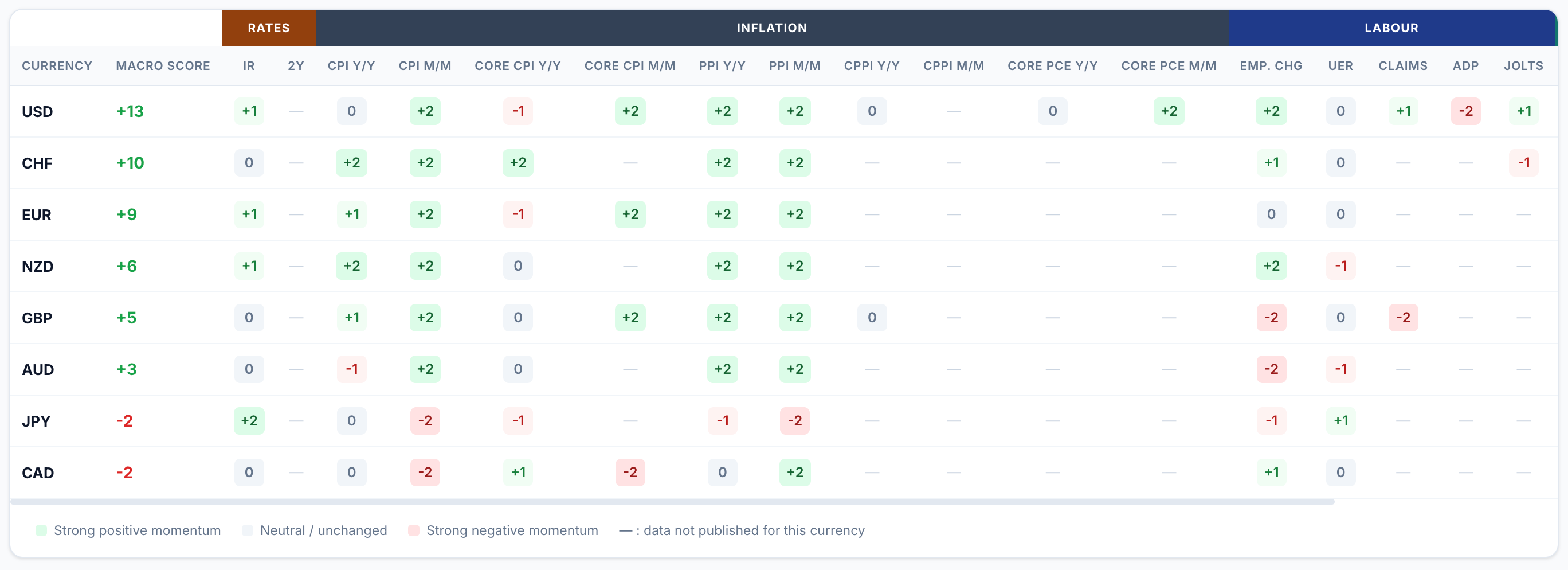
Macro Dashboard
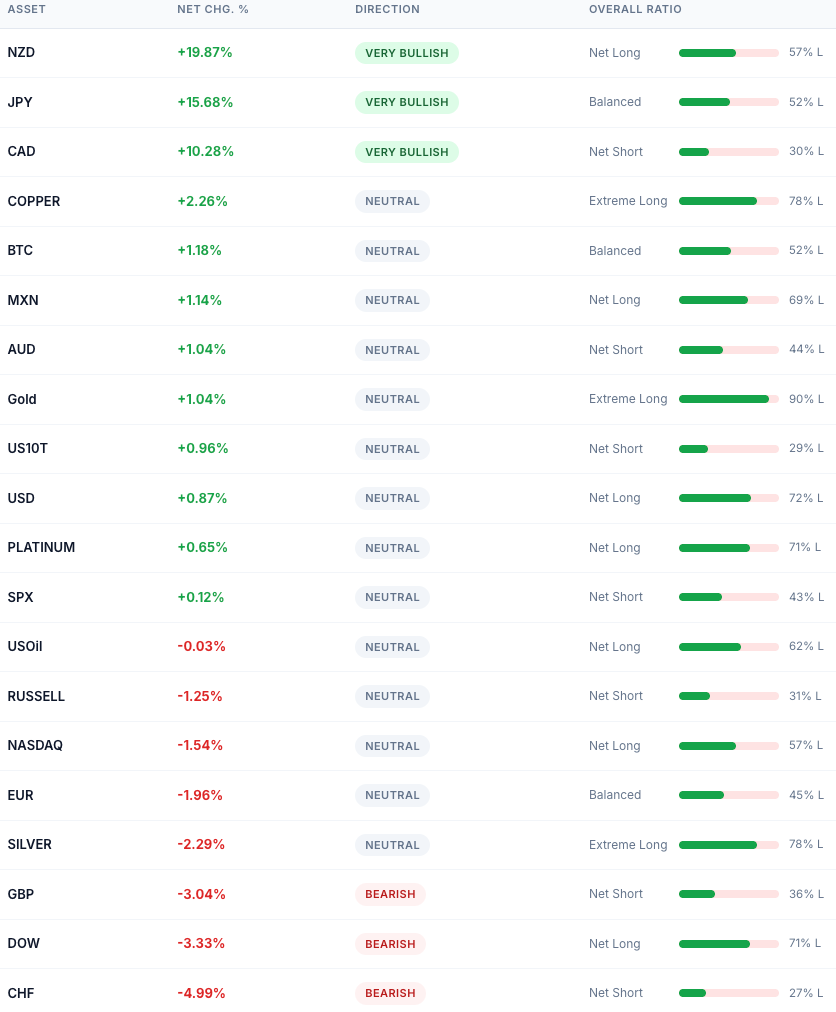
Institutional Positioning
Wishing you a successful week ahead,
David Gauch — Founder, Gauch Research