

Hello and welcome back to another SVC Update.
Looking back at the past week, the FOMC delivered exactly the decision markets expected and almost none of the clarity they wanted. Rates were left unchanged, three regional presidents voted to hike, and Chairman Warsh spent the press conference actively refusing to steer. The result was a Dollar that gave back ground, a long end that sold off hard, and a September meeting that is now genuinely live in both directions.
With the Fed offering no guidance, the data has to do the work.
A Hawkish Hold Without a Compass
The FOMC held the target range at 3.50–3.75% for the second meeting under Chairman Warsh, a level unchanged since December 2025. There were effectively no changes to the policy language or the macro outlook. Set the July 29th statement next to the June 17th version and the documents are near-identical apart from a single verb and the paragraph at the bottom naming the dissenters.
Those dissenters are the story. Hammack, Kashkari and Logan all voted to raise rates by 25bps, producing a 9–3 split. Markets went into the meeting unusually nervous about a surprise hike, but Fed Funds probabilities were only in the low 30% range, well short of the ~60%+ threshold that has historically preceded an actual move. The initial reaction was therefore a bull steepening, with the hike priced out and the front end rallying.
What began as a hawkish hold quickly turned into something more ambiguous. Warsh kept inflation front and centre as the Committee’s primary concern, but most answers were deliberately opaque. Asked whether this was a pause, he responded:
“So, I wouldn’t characterize what we did as anything like a pause. I would characterize what we did as a rigorous review of the economic situation. I would characterize what we did as a review of the big, hard questions, and I’d characterize it as a view of what our own homework is, to try to resolve those questions and the period ahead.”
On the 2% target and the decision not to act now:
“I would again reiterate. What we do isn’t just about what we say. It’s not just about what we do. We’re in the performance business and so if I look at the Treasury curve, if I look at the dollar, if I look at a lot of things that are internals inside of financial markets, I think what they’re broadly saying is, that this committee does own it.”
And on the three-way split:
“So, could people come to different conclusions? Absolutely, but my own judgment is this is a period of watchful thinking, not watchful waiting and I think the score on that vote was unanimous.”
The most useful line of the whole session was arguably his framing of how markets should approach the Fed: “Market participants are learning to play the ball, not the referee.” Read literally, that is an invitation to trade the data rather than the dot plot, which is convenient, because there is no dot plot to trade.
If Greenspan is the template here, we should expect more of the same. Our working assumption is that Warsh will continue to buy time and avoid committing, using the vote tally rather than the statement as his de facto forward guidance.
The Long End Did the Talking
The more instructive reaction came after the press conference. Without a clear read on Warsh’s reaction function, and with no hike delivered, markets began challenging the Fed’s inflation credibility directly. There is also a growing concern that the Committee may choose to tighten via the balance sheet rather than the policy rate.
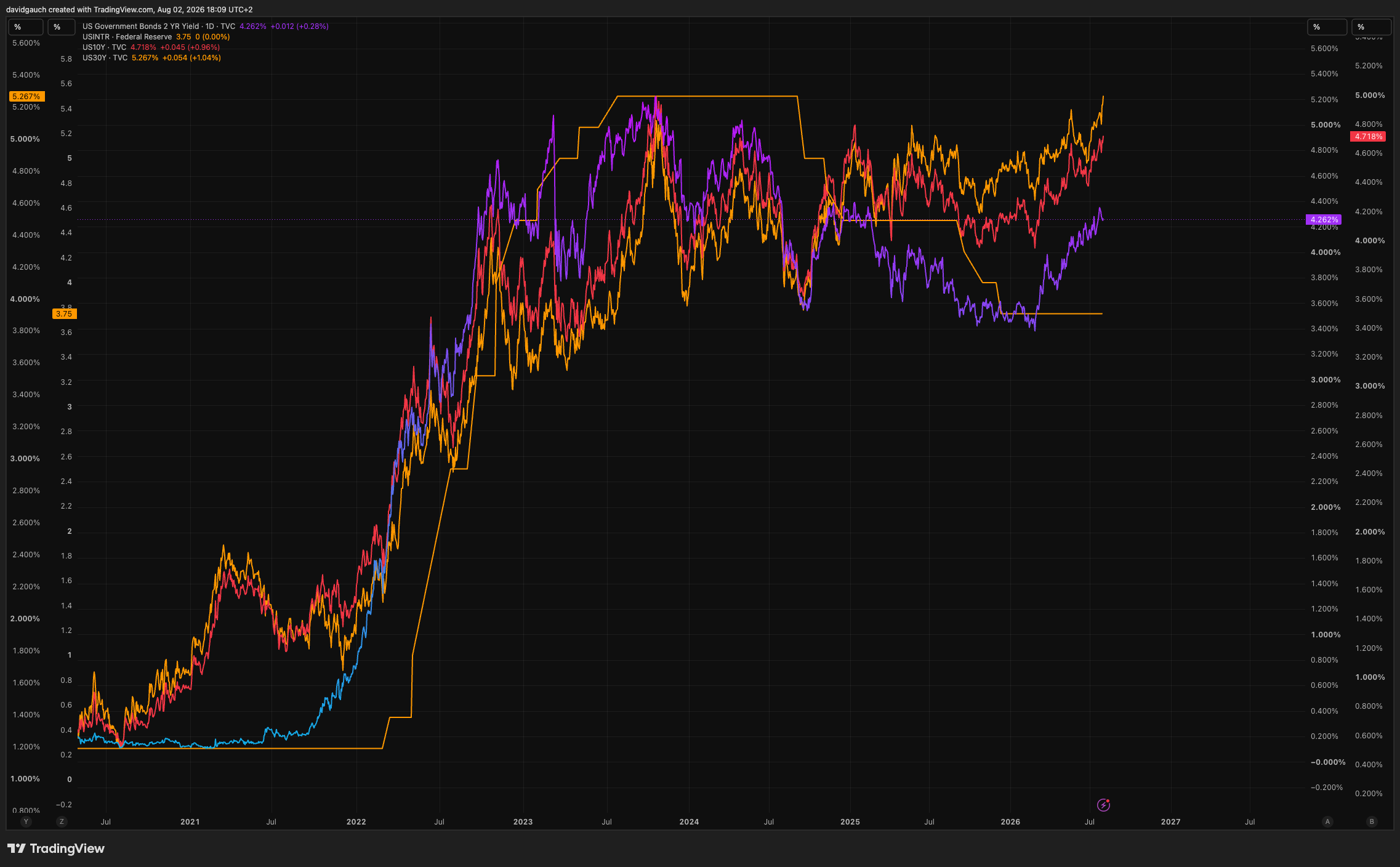
The curve bear steepened, with 30-year yields posting one of the largest selloffs at an FOMC meeting in over a decade. The back end got no help from asset allocation flows either, with equities closing on the lows. Long-dated rates now sit at multi-decade highs, a point that matters directly for Monday’s and Wednesday’s refunding announcements, where policymakers will be reluctant to do anything that pushes term premium higher still.
Current Fed Pricing
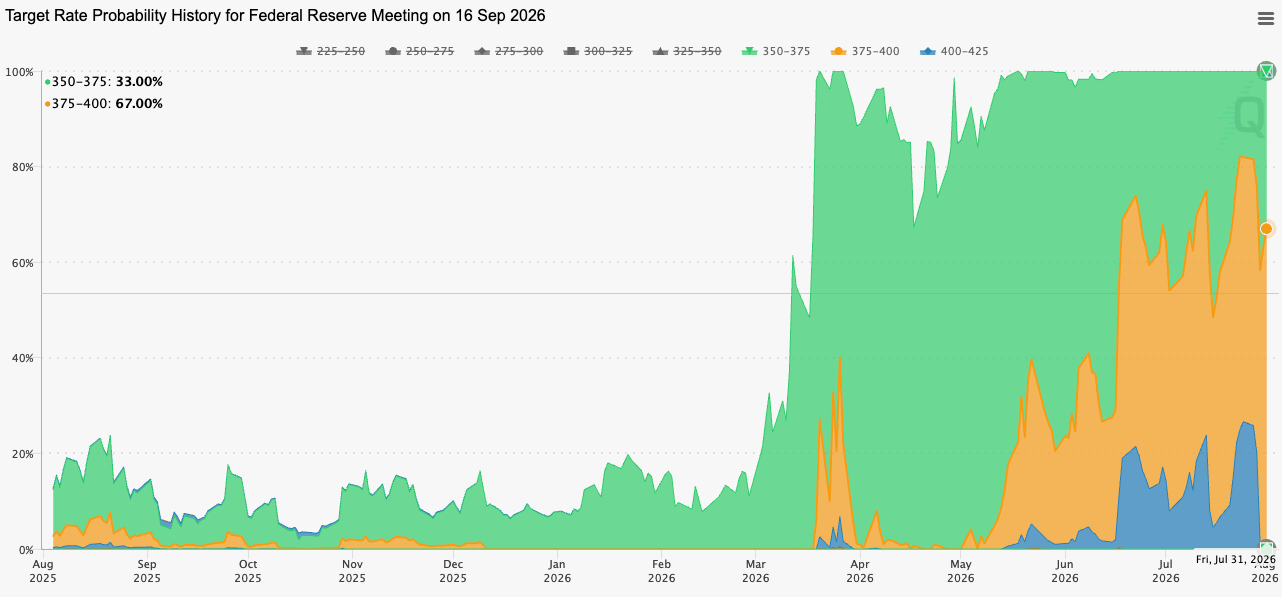
Prior to the meeting, money markets had almost fully priced a September hike. That has now been scaled back to roughly 67%, and the repricing has been the primary driver of the Dollar’s softness. The DXY fell 1.31% on the week to just above the 100 handle, with EUR/USD holding near 1.1530, GBP/USD near 1.3480 and USD/JPY around 159.10 after suspected intervention. WTI dropped 5.93% to $84.01, which took some of the near-term inflation pressure out of the picture and reinforced the dovish repricing.
Payrolls Take Over the Steering Wheel
The September meeting is eight weeks away, the longest inter-meeting gap of the year. Between now and then the Committee gets two employment reports, two inflation reports and Jackson Hole. September is not a done deal in either direction, and this week is the first meaningful input.
Friday’s July payrolls report is the main event. Consensus sits around 88K after June’s 57K miss, with the unemployment rate expected to hold at 4.2%. A print in that range would be the Goldilocks outcome, soft enough to keep the Fed on hold in September, firm enough to avoid recession pricing.
The risk, in my view, is asymmetric to the downside. Recent labour data has been consistently weak, and with markets already questioning whether the Fed is willing to translate its price-stability rhetoric into actual tightening, a disappointment would trigger a larger dovish repricing than a comparable miss would have done a month ago, particularly if oil stays under pressure.
On the inflation side, core PCE eased to 3.3% YoY from 3.4%, which combined with the cooler June CPI gave the Committee just enough cover to sit still. That is the balance the labour data now has to either confirm or break.
Europe: Energy Is Still the Only Variable That Matters
The Eurozone story remains the energy shock. The ongoing conflict in the Middle East and the associated supply disruptions continue to drag on the region, and the duration of that conflict is ultimately the determining factor. Recent developments have increased, not reduced inflation risks.
Sticky inflation paired with resilient activity keeps the Euro supported, but stronger US data caps the upside. EUR/USD has been more resilient than the relative surprise indices would imply, which continues to tell us that FX is trading rate expectations and capital flows rather than short-term macro beats and misses.
Upside Risk for the Yen Remains
The development that changes the Yen calculus did not come from the Bank of Japan. The US Treasury bought Yen on Friday, Washington’s first Yen-buying intervention alongside Tokyo since 2011, and signalled to banks that further action may follow. USD/JPY closed near 157.6 after trading close to 164 earlier in the period. Japan’s own operations remain suspected rather than confirmed. Reports suggest the two sides may unveil a joint policy as early as this week; how that framework is constructed will matter more than any single operation.
Elsewhere
CAD: July jobs Friday, following strong Q2 GDP. Markets price ~70% for a December hike and fully price January 2027.
NZD: Q2 employment Thursday, unemployment expected to tick up to 5.4% following the RBNZ’s pivot back to tightening.
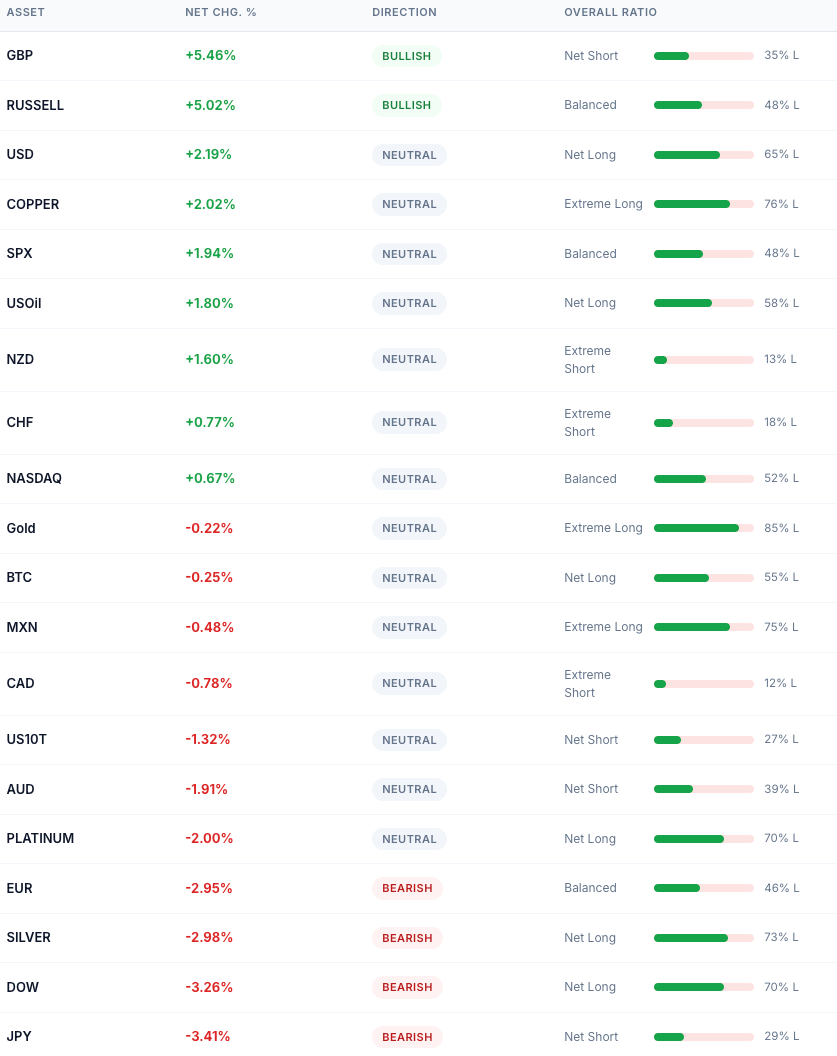
Institutional Positioning
Visualizer from the Gauch Research Terminal (Premium Access Only).
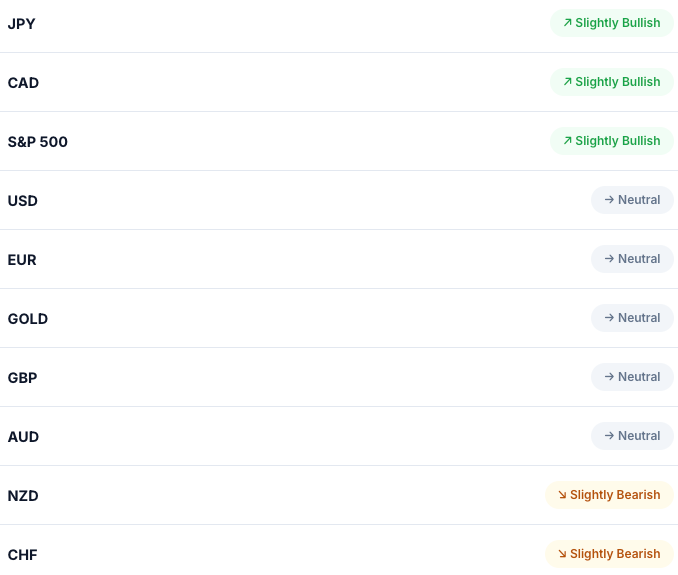
Outlook
Upcoming News
USD ISM PMI’s
NZD UE Rate + Employment Change
USD Non-Farm Payrolls
CAD UE Rate + Employment Change
Wishing you a successful week ahead,
David Gauch — Founder, Gauch Research