

USD
A weak jobs report and a stronger Dollar.
September payrolls added only 29k jobs against 84k expected, and unemployment rose to 4.2%. Money markets cut the odds of an Oct. 28 hike from about 70% to 18% within a few days. They still price at least three hikes over the next twelve months, which looks too aggressive, and December is the more likely date for the next move. The Dollar’s strength is mostly a euro story: against the yen and the franc it barely moved. Long-end Treasury yields still rose to multi-year highs. Wednesday’s FOMC minutes cover a meeting held before the payroll miss, so hawkish wording has a short shelf life. ISM services came in today at 54.9 versus 55.4 prior, trade data tomorrow and preliminary UMich Friday (48.0 consensus). Overall skew: firm against the euro, limited upside against JPY and CHF. Front-end pricing has more room to fall than to rise.
EUR
France prices like the periphery.
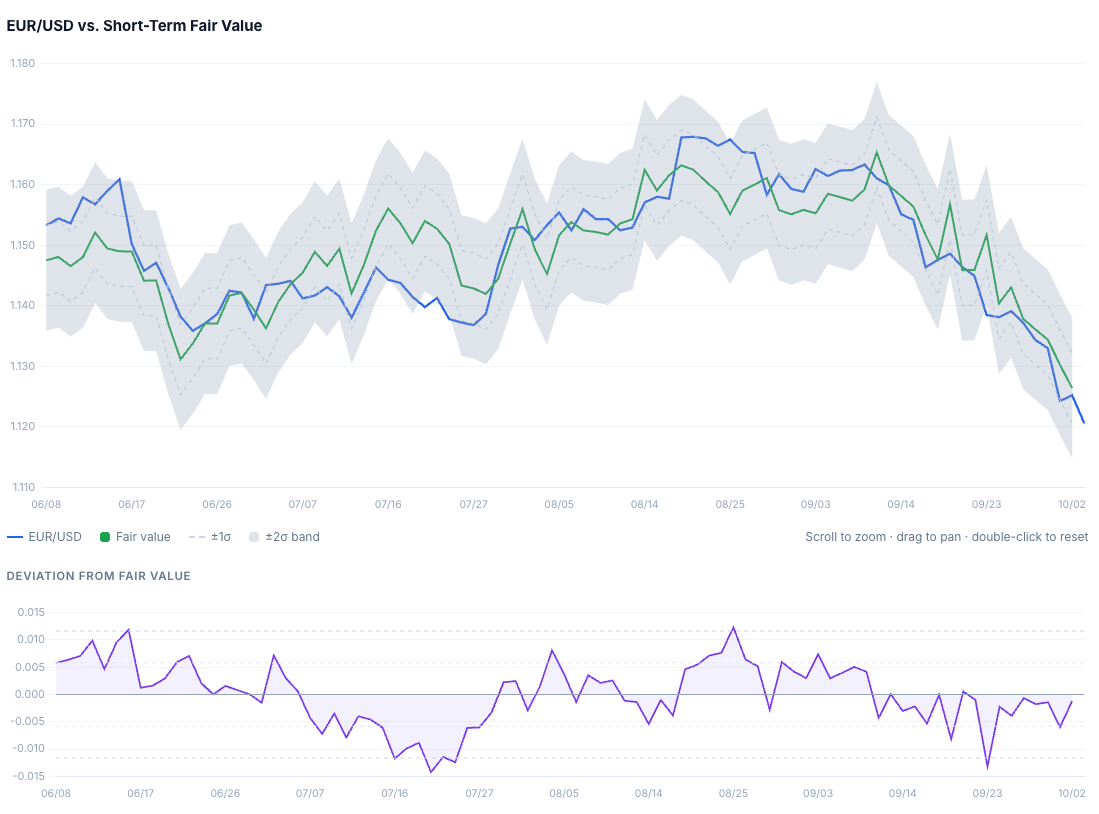
Paris sets the direction for the euro. French 10Y yields have climbed to their highest since 2002 while Bunds rallied, and the OAT-Bund spread is now wider than Italy’s. The budget should pass if Le Pen backs it to avoid a bond crisis, but until then the spread stays the main driver. Inflation alone would support hikes: the flash HICP rose to 3.8% against 3.6% expected, core edged up to 2.5% and services to 3.2%. Even so, markets give an Oct. 29 hike only a 26% chance. Lagarde said higher long-term yields “will slow growth and reduce pass-through by more than projected”, and the market took that as a reason for the ECB to hold back. Data: final services PMI today at 53.0, German factory orders and euro-area retail sales tomorrow, German industrial production Wednesday. Overall skew: soft. Short EUR/JPY around 177.70 is the cleaner trade, and EUR/CHF at 0.9328 is the best gauge of fragmentation stress.
GBP
Gilts held, and sterling gained in Europe.
Gilts barely moved, and next to France that is enough for sterling to work as the more stable option in Europe. The calendar is thin: final services PMI today at 52.1 versus 51.7 prior, BoE credit conditions survey and Bailey on Thursday. Supply is heavy, with index-linked 2035s tomorrow and 2031s and 2028s Wednesday. The Oct. 28 budget remains the bigger risk for gilts. Overall skew: neutral vs USD, constructive vs EUR as long as the OAT spread stays wide.
JPY
The yen gains on the crosses, not against the Dollar.
MoF weekly flow data show foreign investors were heavy sellers of Japanese equities, though the Nikkei still gained 2.9% to 68,309. Ueda speaks tomorrow, the BoJ’s branch managers meet Thursday with the regional economic report, and the timing of the next hike is the open question. Labour cash earnings come Tuesday night (3.7% consensus after 4.3%), the current account Thursday, household spending Friday. The MoF auctions roughly 2.6tn Yen of 10Y paper Tuesday and 600bn Yen of 30Y Thursday. Overall skew: express yen strength through EUR/JPY rather than short USD/JPY while US long-end yields keep rising.
CHF
The franc is back as a safe haven.
After four months of weakness, the franc is in demand again, driven by fragmentation fears around France. Swiss yields fell alongside Bunds. September CPI matched expectations at 1.0% y/y, a two-year high, with prices flat on the month. That does not change the SNB’s 0% stance, but it makes clear that a weaker franc would be welcome. No major Swiss data this week. Overall skew: franc strength vs EUR as long as the OAT spread does not narrow. Below 0.93, intervention talk becomes more likely (as seen today).
AUD
The RBA delivered, and AUD fell anyway.
The RBA raised the cash rate 25bp to 4.60% in a unanimous vote and left the door open to further hikes “if needed”. August CPI rose to 4.0%. None of it helped the currency. Rising global yields and weaker risk appetite matter more than the domestic rate story. Australian 10Y yields are just below a 15-year high, and the third US carrier group heading to the Middle East keeps upward pressure on them. The domestic calendar is quiet, with PMIs Wednesday and inflation expectations Thursday. Overall skew: soft vs USD in the near term, with the June low near 0.690 as the next level. AUD/NZD at 1.2392 remains the better expression of the RBA’s hawkishness.
NZD
Nothing to lean on.
With no domestic catalysts, NZD trades off global yields and equities. Overall skew: soft.
CAD
A low rate gives the BoC room to move.
September jobs on Friday are expected at +5.0k after −41.7k. A partial rebound would keep a December hike in view. With the policy rate at 2.25% and Canadian yields rising less than elsewhere, the BoC has room for modest tightening. Politics adds a domestic risk: Quebec votes on Oct. 5, where the separatist Parti Québécois could take power, and Alberta holds a non-binding referendum on Oct. 19. August trade data come Tuesday. Overall skew: soft near term. A PQ win puts a separatism premium on CAD before the jobs data matter.
Cross-Asset Notes
Europe takes the hit, Japan holds up.
With US long yields rising, gold is not acting as a hedge right now. The deployment of a third US carrier group and 10,000 Marines keeps the risk premium in oil.
The FOMC minutes on Wednesday set the tone for US rates. In Europe, the OAT spread matters more this week than any data release.
EUR/USD Fair Value
Institutional Positioning
Wishing you a successful week ahead,
David Gauch — Founder, Gauch Research