

USD
Structurally fragile; Jackson Hole is the week’s binary.
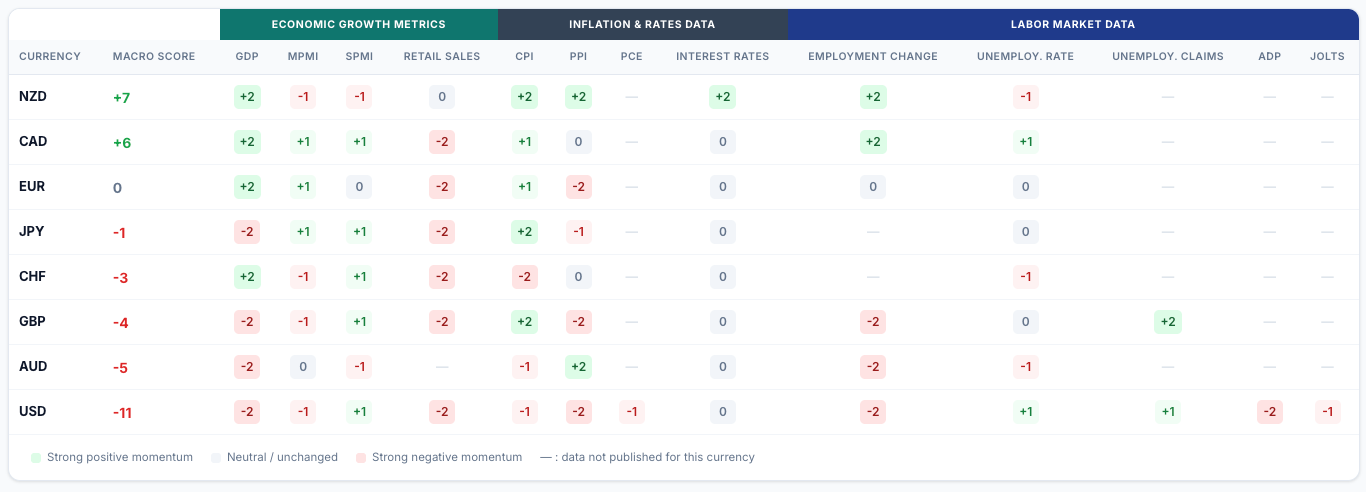
The defining feature of this market is a non-reaction: 2Y at 4.24%, 10Y at 4.74%, 30Y at 5.27% and a 10Y real yield of 2.40%, with services PMI at 56.8 and composite at 56.0, and the Dollar still fell, DXY closing near 98.8 and down roughly 0.9% on the week. High rates no longer buy Dollar strength. Over four weeks the USD is down close to 3%, the worst run since the Liberation Day fallout, and the common thread in both episodes is that the move was triggered by policy out of Washington rather than by the data. Warsh’s Jackson Hole appearance on Thursday is the centrepiece. He has to avoid a post-speech Treasury sell-off without pivoting so far toward guidance that he looks beholden to a Treasury trying to cap long-end yields, a narrow path, we expect no change in his no-guidance approach. Markets want a reaction function and a reaffirmation of the Fed’s inflation-fighting credentials. Wednesday’s July PCE (core 0.2% MoM, 3.3% YoY expected) alongside the Q2 GDP second estimate is the data anchor; Friday brings the preliminary benchmark payrolls revision, where consensus expects another negative print after last year’s record -911k. December is now almost fully priced for a 25bp hike. Overall skew: selectively bearish USD, but the risk of a hawkish Warsh reasserting rates dominance is real.
EUR
Model leader and the cleanest expression of the Dollar view.
Eurozone activity is holding up better than the energy backdrop implies, composite PMI at 52.1, manufacturing 52.8, services 51.7, with new orders strong and export orders positive for the first time since 2022. EUR/USD trades around 1.1682 after a Friday high of 1.1711. Friday’s flash French and Spanish August CPI prints are the week’s key releases ahead of the ECB on 10 September, with markets pricing a 95% probability of a 25bp hike to a 2.50% deposit rate. Models see headline inflation pushing above 3.5% later this year if current energy prices persist, which if anything hardens the hawkish case. German Q2 GDP detail and ifo Tuesday, GfK Thursday alongside the ECB July accounts, German labour data and EC surveys Friday. The counterweight is Brent near $94, a terms-of-trade drag that prevents this from being a clean long-Europe trade rather than a selective short-USD one. Overall skew: constructive, though we would wait for the pullback to hold and for cross-breadth to confirm rather than chase.
GBP
Constructive but derivative; reserve rather than lead.
Activity is resilient with services PMI at 52.8, composite 52.5 and manufacturing 51.5, and cable has posted a fourth consecutive positive week around 1.365. Carry remains supportive with the BoE at 3.75% and services inflation still at 3.4% against headline 2.9% and core 2.6%. The problem is not the idea but the overlap: Sterling is currently trading the same short-USD beta as the Euro, and July retail sales at -0.5% MoM plus persistent UK fiscal risk make it the weaker leg. The domestic calendar is almost empty. We want to see GBP confirm against EUR or JPY before treating it as anything other than a substitute. Overall skew: mildly positive, but we would not run it in parallel with EUR/USD.
JPY
Macro case improving; price and carry still refuse to pay for it.
July core CPI at 1.8% and core-core at 1.9%, with manufacturing PMI 55.1 and services 52.3, leave a September hike to 1.25% broadly expected, market pricing sits around 82%. Two events matter: Deputy Governor Himino speaks Thursday, where the question is less whether the BoJ hikes than whether it accelerates, and Tokyo August CPI lands Friday with headline expected to ease to 1.9% and ex-fresh food to 1.7%. Joint intervention has driven a further liquidation of yen shorts, but USD/JPY is still near 159.0 and the carry remains heavily negative. Intervention can turn a price abruptly; it does not manufacture a trend, and the US front-end advantage remains large. Oil import costs are an additional drag. Overall skew: watch, not long, we want broad JPY strength across several crosses and a failed USD/JPY rebound before engaging.
AUD
Wednesday’s CPI is the only thing that matters.
The RBA holds at 4.35% and continues to warn that inflation is too high and further hikes cannot be ruled out, so an upside surprise in July inflation would quickly rebuild pricing for a move before year-end. Tuesday’s minutes should be a non-event given both the Governor and Deputy have already spoken since the decision. The counterweight is the labour market, which is now clearly cooling: July employment -15.8k, unemployment at 4.5% and hours worked -0.6%. AUD/USD around 0.7168 has been better in price than the fundamentals justify, and China beta remains unhelpful. Overall skew: price positive, position neutral, better expressed against the JPY than the USD.
CAD
Flat. The trade story has replaced the macro story.
On paper the CAD case is intact: the BoC at 2.25%, retail sales +0.6% MoM, CPI at 3.0%, Brent at $94.39, and Friday’s Q2 GDP expected to rebound to around 3.3-3.4% annualised after three negative quarters out of four, with ING looking for better net trade, stronger consumer spending and a large investment rebound. But Canada has confirmed retaliatory tariffs effective 8 September across several sectors, which overwrites the earlier relief on the avoided 50% US tariff threat and introduces a standalone political risk premium. Oil and rate differentials are not sufficient against a domestic trade shock with no new talks scheduled. Overall skew: no view. We are flat CAD until new negotiations or exemptions emerge alongside price confirmation.
NZD
Record shorts against a thin domestic case.
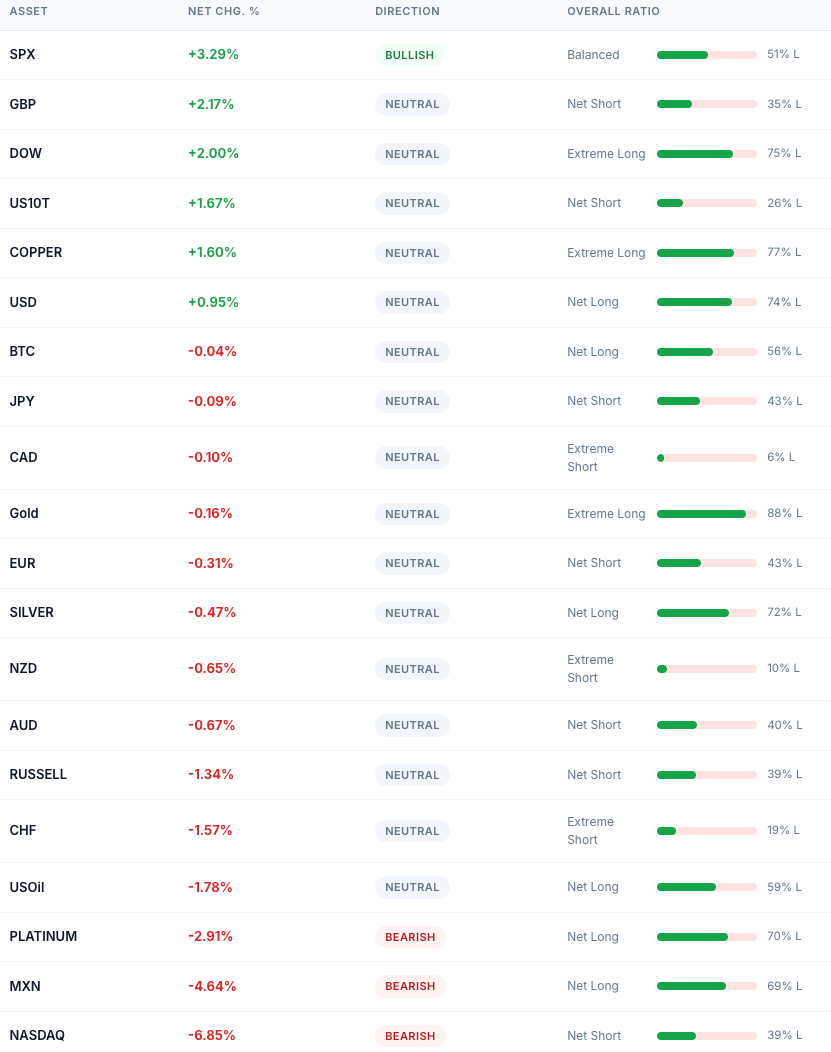
Data shows NZD shorts at a new record going back to 2006, reflecting scepticism that the RBNZ delivers the nearly 100bp of tightening currently implied. With the OCR at 2.50%, Q2 unemployment at 5.6%, wage growth at 2.0% and inflation at 4.1%, that scepticism is not unreasonable, labour slack caps the quality of any structural long. Monday’s Q2 retail sales will indicate how consumers are absorbing higher fuel prices; business surveys and card transactions point to reasonable nominal growth, with volumes likely flat given price effects. Positioning that stretched cuts both ways. Overall skew: tactically positive on price, no structural conviction.
CHF
A clean conflict between model and market.
On fundamentals the Franc should not be bid, the SNB at 0% with a low inflation forecast argues against any durable long, and the SNB’s willingness to intervene caps rapid appreciation. Yet the Franc has been among the strongest currencies on price this week, which tells us haven flows are doing the work and that the rate disadvantage becomes irrelevant under confidence stress. We take that as information rather than noise: it is a reason to stand aside, not to fade. Overall skew: neutral.
Cross-Asset Notes
Gold has paid the confidence trade most cleanly; oil keeps duration risk alive.
Gold closed for a weekly gain of over 5%, well above its 200-day at roughly $4,513, with silver confirming the breadth, but with the long end this elevated, chasing after a move of that size is poor asymmetry. WTI at $87 keep energy inflation active; individual Iraqi tankers are passing through Hormuz but traffic remains heavily reduced, so this is marginal relief rather than normalisation. The key cross-asset channel is simple: high oil plus a high long end is a negative duration factor. That is already visible in equities, with the S&P down 1.4% on the week, the Nasdaq down 2%, and the VIX closed at 15. This is a fragile fiscal and duration regime, not a systemic one. NVIDIA reports Wednesday alongside PCE, a double test we would not want to carry an elevated bias into.
Macro Dashboard
Institutional Positioning
Wishing you a successful week ahead,
David Gauch — Founder, Gauch Research